Number one choice in football trips
10 Reviews
I would like to take this opportunity to thank Footballbreak.co.uk very much and in particular Rebecca for what can only be described as the trip of a life time.
Read more reviews
A visit to a live home match of Real Madrid, the Royal Club, is one very special experience. The wonderful past players, the classic white strip, the awesome stadium and...José Mourinho - everything about this club is very special!
See world-class players like Ronaldo, Kaká, Casillas and Pepe play in the impressive Bernabeu stadium and enjoy the historic capital city of Madrid during your stay. Book your trip now easily online and you are assured of an unforgettable evening with top players in the immense Bernabeu stadium in Madrid!
All our Real Madrid football packages include:
Football matches in Spain are scheduled to be played on a Sunday evening. Our Barcelona packages are planned from Saturday until Monday as there is a possibility that the game could be played on Saturday instead. The confirmed day will be announced approximately 10 days prior to the match taking place.
The Most Successful Football Club in the World
Real Madrid has won the Champions League (or its predecessor, the European Cup) nine times and the World Cup three times. This makes Real Madrid the most successful football club in the world. Because of these successes, FIFA named Real Madrid the best football club of the 20th century. The glory years of the club were in the mid fifties to early sixties, when Real Madrid dominated national and international football with many national titles and five consecutive wins in the European Cup. Real Madrid was also very successful in the late 90s and at the beginning of the 21st century, with three Champions League victories (1998, 2000, 2002). However, after the re-emergence of FC Barcelona, the club was less successful both nationally and internationally. The club tries to revive old times under current coach Jose Mourinho and superstar player Cristiano Ronaldo of course.

Starplayer Cristiano Ronaldo in the spotlights.
Not forgetting other players like Mesut Özil, Kaka and goalkeeper Iker Casillas. Real Madrid definitely now has the right quality of players to stop the hegemony of FC Barcelona. The last years the club reached the semifinals of the Champions League and won the Spanish League after defeating Barcelona in the final. Last season they also won the landstitle! Winning the Champions League is their next goal and would be the ultimate crown on Mourinho’s job in Madrid and they will definitly.
El Clasico
Real Madrid has several rivalries with other clubs in Spain. Besides the Derbys against Atlético, the matches against life-long rival FC Barcelona are infamous. Last season Real took on Barcelona five times. Real only won the cup final.. Barcelona beat Real in both their two league games (including a 0-5 win in the Bernabeu) and in the semifinals of the Champions League. The last game between the two teams was at the beginning of this season for the Spanish Supercup. Real Madrid won and captured the Cup. The total of 'El Clásico' is still in favour of Real Madrid!
Origins of Madrid FC. and the Start of La Liga
Football was introduced to Madrid by students and professors from the Libre de Enseñanza Institución. Some of these students had studied in England. In 1895 they founded a football club called Football Club Sky. Madrid FC (the current Real Madrid) was founded on March 6, 1902, a spin-off from the original Football ClubSky In 1905 Madrid FC won its first major trophy, the Copa del Rey (the Spanish Cup), an achievement they would repeat on three consecutive years. In 1920, King Alfonso XIII gave Madrid FC, (as well as some other football teams in Spain) the royal title, hence the name Real Madrid which means "Royal Madrid". Real Madrid formed the basis for the creation of La Liga (1929), the national competition, which they won in the 1931-32 season for the first time and held the following year.
Santiago Bernabeu and the Glory Years
In 1945 Santiago Bernabeu Yeste became president of Real Madrid. Before being president of the club he was a player in Real Madrid's First team (an attacker with more than 200 goals), assistant coach and then head coach. He achieved an impressive development of the club. The Santiago Bernabeu stadium was built and good training facilities were established. He also started the tactic of signing foreign players to Real Madrid, including the famous Alfredo Di Stefano and Ferenc Puskas. It was also Bernabeu who worked together with a journalist from the French sports daily L'Equipe and founded an international tournament for European Champions, which later would become the UEFA Champions League. Real Madrid won this prestigious tournament five times in succession between 1956 and 1960, and again in 1966. Real Madrid dominated the Primera Liga in the 70’s, winning the Championship five times and the Spanish Cup three times.
Los Galacticos
The recent summers were relatively quiet for Real Madrid. The only major signing was Fábio Coentrão who was bought from Benfica for € 30 million. In recent years the club has paid astronomical amounts for some of the best players in the world. At the beginning of this century, Real signed players such as Zidane, Figo, Ronaldo and Beckham. This star team that won, among other prizes, the Champions League was thereafter known as Los Galacticos. Although initially it was a positive nickname, the lack of continued success eventually gave the term a negative connotation. Real Madrid also has the dubious honour of paying the highest transfer fee for a football player in the world; Cristiano Ronaldo was bought from Manchester United for a staggering 94 million euros. Real Madrid was also responsible for making Zinedine Zidane and Luis Figo the most expensive football players of their time.
The Richest Football Club in the World
Besides being the most successful, Real Madrid is also the richest football club in the world. TV rights, sponsoring, ticketing and merchandise add up to an annual turnover of around € 440 million per year. However, the club has a huge debt; an estimated € 330 million. This is not a rare phenomenon for major football clubs in Spain (and in England too!).
British Players at Real Madrid
Several British players have worn the magic white shirt of Real Madrid; - David Beckham, - Michael Owen - Steve McManaman - Jonathan Woodgate - Laurie Cunningham. Surprisingly, Steve McManaman is the most succesful amongst this list; he won both the Champions League and La Liga twice. He scored the winning goal and was chosen as Man of the Match in the Champions League final of 2000 against Valencia.
Shirt and logo
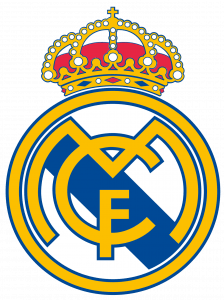
Real Madrid home kit is completely white. Originally Real used to have a blue stripe running diagonally across the white shirt. Although now removed from the shirt, the blue stripe is still reflected in the logo of the club. The away shirt is either solid black or solid purple. The logo of Real Madrid has always been a circle with the three letters MCF superimposed over each other.

The logo with the crown on top.
A crown was added to the logo after the royal title was given to the club. When in 1931, the monarchy was abolished, the royal title and the crown were removed. They were both restored in 1941, two years after the civil war ended.
Real Madrid plays its home games in the Santiago Bernabéu Stadium, named after the president who was very important in the history of the club.
In December 14, 1947, a new stadium was built and in 1955 it was renamed after the incumbent president who had commissioned the construction. Initially, the stadium had a capacity of 75,145, more than half of which were standing places. Expansion in the mid 50’s increased the capacity to 120,000.
Eventually, due to the UEFA requirement that all spectators had to have seats, the stadium lost much of this capacity. The current capacity is 80,354 spectators.
Estadio Santiago Bernabéu (Stadium Tour)
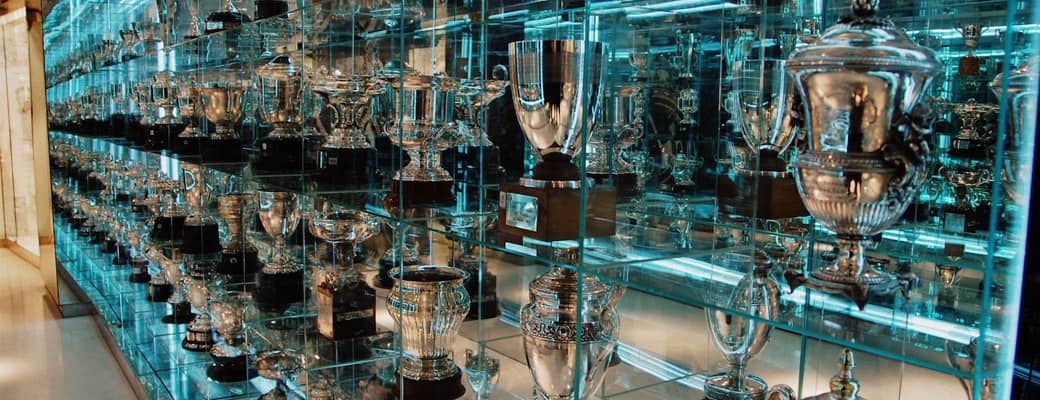
A behind-the-scenes stadium tour of the Bernabeu is a must for any Real Madrid fan. See the huge size and scale of the stadium from one of the eight glass elevators around the stadium. Visit the Trophy Room with hundreds of cups on display recording Real’s successful history. Watch videos of legendary moments of play, pictures of players past and present, see the ever-changing kit, boots, equipment and a host of other fascinating memorabilia. For football fans this is the #1 must-do attraction.

Estadio Santiago Bernabéu.
Experience the amazing atmosphere of the stadium as you walk around the pitch. As part of the tour you can walk through the tunnel in the steps of all great players and see the benches and coaching area. The tour includes the dressing rooms, press room and presidential balcony where numerous Real Madrid captains have received hard-won titles. Finally, pick up some official merchandise and souvenirs of your momentous visit to the hallowed ground of the Bernabeu Stadium.
Photo's

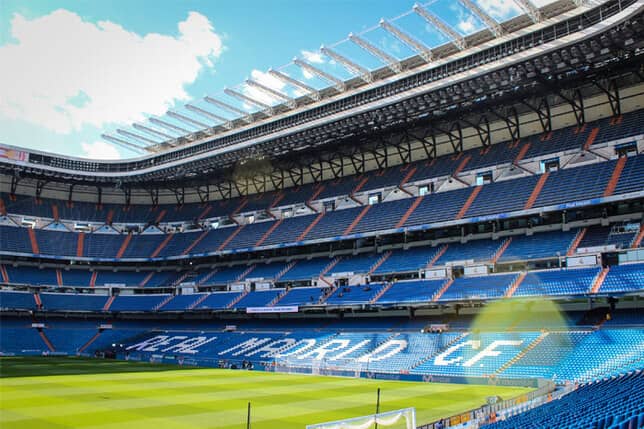
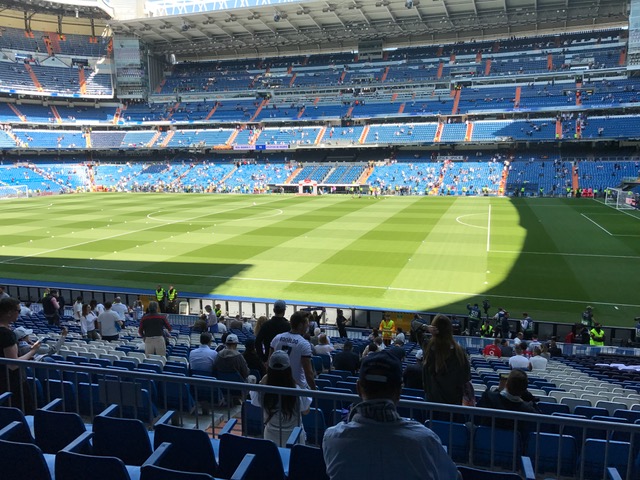
Even without an audiance it is an impressive stadium.

View from the short side.

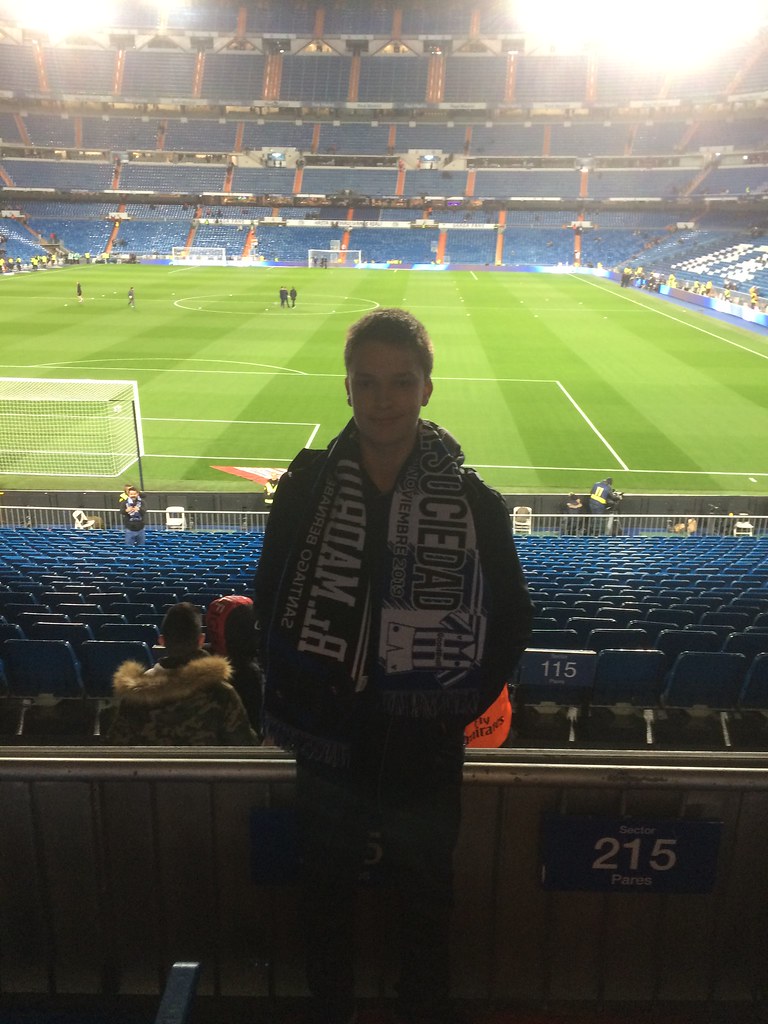
A perfect football evening in Madrid.

The massive stadium in the centre of Madrid.
Madrid, Spain’s capital city, is a vibrant modern city with some great attractions for visitors. The compact city centre has a relaxed atmosphere and some magnificent buildings, museums, parks and attractions for visitors. With great food, cheap wine and beer, excellent shopping and a sunny climate, Madrid is a great place to visit on a football break!
Here are some highlights of things to see and do during your visit to Madrid:
Retiro Parc
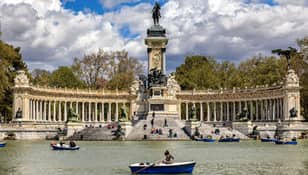
Due to its location in the middle of the country, Madrid does not have a beach but it does have beautiful parks and gardens which attract many visitors, especially in the summer months. The best known and perhaps most attractive of all is the “Parque del Buen Retiro”. This was originally the exclusive retreat of the Royal family but has been opened to the public since the 2nd half of the 18th century. The park is full of beautiful sights, including the "Palacio de Cristal" (glass palace), the monument for Alfonso XII and the rowing boats on "El estanque", the lake in the north of the park. The boats really are worth checking out. The busiest and also most interesting day in the Retiro is Sunday, when many street artists and musicians comer here to display their talents.
Metro: Retiro or Atocha

The Buen Retiro Park, a unique parc in the heart of centre.
Palacio Real
The Palacio Real (Royal Palace) is wonderfully situated in the west of the city. It’s an enormous white palace with its own cathedral on the left, the “Catedral de Nuesra sẽnora de la Almudena”. Inside, it’s like a fairytale palace, which has all the trimmings, with gold in abundance and lavish decorations. The complex includes not only the palace itself but also the Royal pharmacy, arsenal and library. In the north of the Palace grounds, we find the "Jardines de Sabatini", the wonderfully nurtured palace gardens.
Location: Calle de Bailen
Metro: Opera

The impressive Royal Palace an unmissable landmark in Madrid.
Fuente de Neptuno (Neptune’s Fountain)
This gorgeous fountain by 18th century sculptor Ventura Rodriguez is a local landmark. It shows King Neptune being transported in a shell-shaped carriage, pulled by two horses.
Location: Plaza de Canovas del Castillo
Metro: Banco de Espana
Gran Via
This main street is definitely not to be missed on your visit to Madrid. It is lined with shops, cinemas and restaurants in distinctive Art Deco style buildings. As you browse around looking for souvenirs, checkout the carved gargoyles at #12 and the Capitol Cinema and Bingo Hall, built in the 1930s. Gran Via runs south to the Puerta del Sol.
Location: Central Madrid
Metro: Gran Via
Puerta del Sol (Gate of the Sun)
This is one of Madrid’s liveliest squares which was once the site of a castle and gatehouse. Look for the Casa de Correos, once the General Post Office and now the government HQ. The lovely baroque building dates back to 1768 and has an interesting clock tower. It has police cells in the basement and the statue of Carlos III outside. Nearby is the paved slab with the symbol showing “Kilometre Zero”, the epicentre of Madrid where all points in Spain are measured from. At the junction of the plaza and the Calle Preciados is a statue of the Madrid coat-of-arms el osso y madrono showing a bear eating the fruit of a strawberry tree.
Location: Central point of Madrid
Metro: Sol

The statue Oso y el Madroño at Puerta del Sol is the symbol of Madrid.
Plaza Mayor
This cobbled plaza is where many events in Madrid’s history took place including bloody bullfights, executions and trials by the Spanish Inquisition. It is surrounded by shady arcades with small shops and cafes. Look out for the painted scenes on the walls of the Casa de la Panaderia (bakery) which are decorated with gorgeous frescoes.
Location: Central Madrid
Metro: Sol and Opera
Plaza Mayor, a lively square with lots of terraces.
Monasterio de las Descalzas Reales (Royal Barefoot Nuns’ Convent)
You are sure to be amazed at the fantastic gold chapel and priceless artworks in this 16th century religious building. This is Madrid’s most famous monastery museum and is still used by Franciscan nuns of the Santa Clara Order who look after the 33 chapels. Guided tours include the fabulous church, grand staircase and a painting of “The Empress Maria” by the famous 18th century artist, Francisco Goya, said to be the “Father of Modern Art”.
Location: Plaza de las Descalzas Reales, 3
Metro: Sol or Callao
El Rastro
Leave time during your visit to Madrid to visit the famous El Rastro Flea Market which lines the streets around Calle de la Ribera de Curtidores on Sundays. CDs, DVDs, clothes, antiques and much more are sold on this bustling street market. Haggling for a lower price is all part of the fun!
Location: Calle de la Ribera de Curtidores
Metro: La Latina or Tirso de Molina
Plaza de Toros Monumental de Las Ventas
No visit to Spain is complete without experiencing a bullfight, an important part of Spanish culture and heritage. This historic bullring in Alcala replicates a typical 13th century bullring with its red brick and ceramic tile architecture. It is the largest bullring in the world seating 23,000 spectators and is often used for rock concerts and political events.

Las Ventas, the bullring of Madrid.
During the bullfight, see the matador use his red and yellow capote (cape) to tire the bull. Next the picador, on horseback, lances the bull to weaken and annoy it. Then banderillos thrust darts into the bull and finally the matador defeats it. Corridas (bull fights) usually take place on Sundays and cheap seats are in the sun while more expensive seats are in the shade! Booking in advance is advisable and more information is available at the official website.
Next to the stables is the Bullfighting Museum, Museo Taureo, which has free admission. It showcases the history of bullfighting and is open Tues-Fri 09:30 to 14:30 and Sundays 10:00 to 13:00. Outside the bullring there are monuments to two of the most famous Spanish bullfighters: Antonio Bienvenida and Jose Cubero.
Location: Calle de Alcalá, 237
Metro: Las Ventas
Faunia
If you fancy spending a day with wildlife this nature park is a zoo with a difference. It has ten themed conservatories with different ecosystems and climates, ranging from Arctic regions to the tropical rainforest. It shows how different animals adapt to the different environments and teaches about the importance of protecting the natural world. With 4,000 animals, a lecture theatre, restaurants and a nursery there is plenty to see and do for all ages.
Location: Avenida de la Comunidades 28
Metro: Valdebernado
Parque Warner Madrid Theme Park
This great amusement park covers a total of 1,235 acres and has five themed areas. It includes a 3D cinema, Looney Tunes Express, water rides, roller coasters, live shows and plenty of shops and restaurants. Costumed cartoon characters interact with visitors and you can have your photograph taken with your favourite cartoon figure.
Location: 25km from Madrid city centre in the San Martin de la Vega area
Access: Via the M-506 and M-301 routes
Getting Around Madrid
The best way to get around Madrid is on foot or using the underground Metro system, which is cheap, fast and reliable. The ten lines covers most of the city and trains run from 06:00 to 01:30. Look for the red, blue and white signs indicating Metro stations. Tickets can be purchased at ticket booths or machines at each station. Books of 10 tickets are the best value and can be shared by a group of people travelling together. The tickets are also valid on buses.
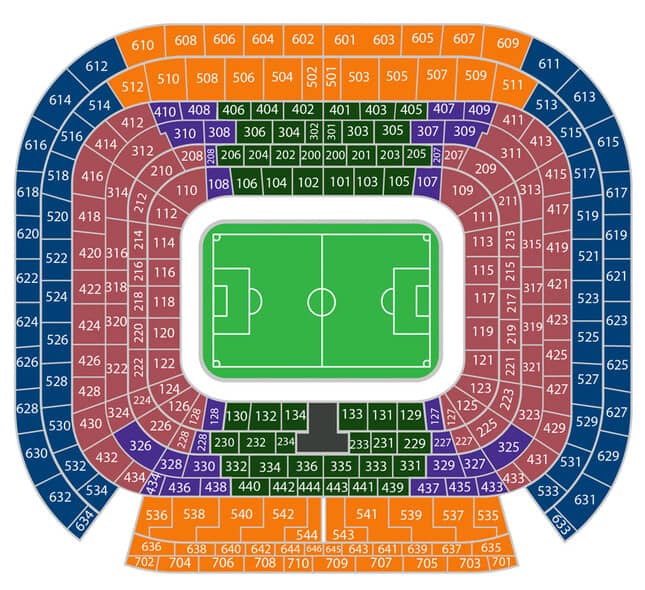
As standard we will reserve category 3 seating for you. It is possible to upgrade your seats should you wish. Upgrades are available to category 2 and category 1. Here is an overview of the seating categories for Real Madrid:
All categories offer you an excellent view of the pitch however it is recommended that you upgrade to at least category 2 for a small supplement as this will bring you even closer to the action!

The supplement per seating is different for each package. In step 2 of the booking procedure you can choose the category of you preference.
Photo's

Category 3 - Seating on the third ring of the short side.

Category 2 - Seating on the lower 2nd ring of short side.


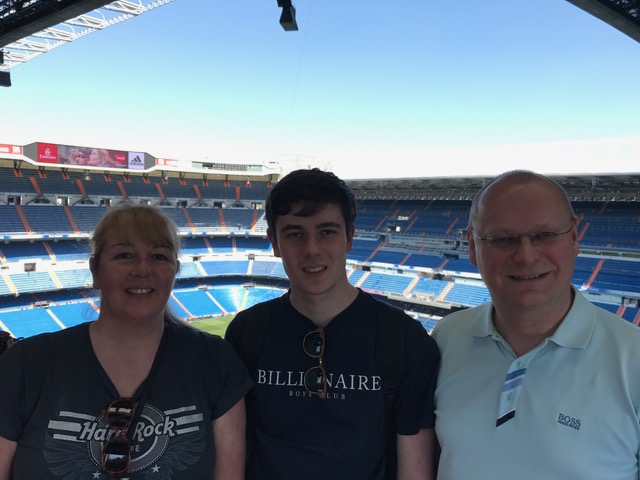
Jamie Cotton & Geoff Cotton in Estadio Santiago Bernabéu


Mr Longmuir at the Bernabeu stadium


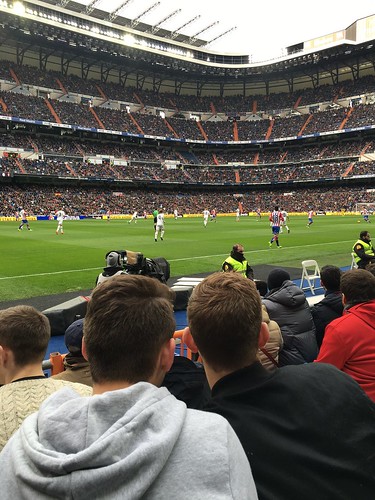
Adam Walker & Dominic Crossley visited Real Madrid