Number one choice in football trips
29 Reviews
We felt that the whole package was superb and great value for money. I would thoroughly recommend Footballbreak to anyone interested in this type of trip as the service we received was superb.
Read more reviews
A visit to a match of FC Barcelona in the gigantic Nou Camp (capacity over 98,000) is a totally unforgettable experience. Barça won the Copa del Rey last season. The team, now trained by Tito Vilanova, is guaranteed to demonstrate some fearless attacking and spectacular football. Watch stars such as Messi, Xavi and Iniesta in action and ofcourse enjoy a long weekend with the delights of the wonderful city of Barcelona.
Book your trip now easily online and you are assured of an unforgettable evening with top players in the amazing Camp Nou Stadium in Barcelona!
All our FC Barcelona football packages include:
Football matches in Spain are scheduled to be played on a Sunday evening. Our Barcelona packages are planned from Saturday until Monday as there is a possibility that the game could be played on Saturday instead. The confirmed day will be announced approximately 10 days prior to the match taking place.
Barcelona Club Information
Presently on top of its game, Barcelona has a rich history with many national and international trophies under its belt. It could be said that Barça is currently having the most successful period in its history. Under the guidance of club manager Joseph ‘Pep’ Guardiola, superb football is resulting in the club winning many trophies. Since the appointment of the coach in the 2008/2009 season the Blaugranas have won as many as 11 trophies including three league and two Champions League titles. The style of play that was originally introduced in Barcelona by Dutch coach Rinus Michel (football combined with high speed and constant pressure at the front) has become the trademark of the club. With the quality players that Barcelona possesses, this often results in spectacular football.
Success in the past does not guarantee success in the future, which is something that especially holds true for football. That’s why two top players were signed this summer. Sanchez was bought from Udinese for € 35 million euro. Cesc Fabregas was also brought back to the club, where he started as a young player before moving to Arsenal. As Barça always aims to improve its own performance, the future seems assured for the Catalans.
Origins
FC Barcelona was founded in 29 November 1899 by the Swiss Hans Kamper. As a 22-year-old he was actually on his way to Africa where his plan was to help his uncle set up a trading company in sugar. However, he ended up staying in Barcelona. He loved football and started, together with some English and Swiss supporters, the “Barcelona Football Club” following his advert in the sports magazine Los Deportes.

The FC Barcelona logo.
Kamper, who later changed his name to Joan Gamper, chose blue and purple as the club colours and appointed himself as the first captain of the team. He played 48 games between 1899 and 1903, in which he scored more than 100 goals. Thereafter he was president for many years and the driving force behind the continued growth and development of the club. He was less fortunate in his private life. Plagued by personal and financial problems, he committed suicide on July 30, 1930. As a tribute to the founder of the club, FC Barcelona still plays the annual opening game of the season for the Joan Gamper Trophy.
More Than Football, More Than a Club
FC Barcelona is best known for the quality of its football, but Barça is more than just a football club. FC Barcelona is an all-sport club with professional, international top teams in basketball, handball, futsal (5-a-side) and field roller hockey. These are all very popular sports in Spain. Furthermore, the club still has sections for amateur wheelchair basketball, athletics, rugby, baseball, volleyball, hockey, ice hockey and figure skating.
Besides the Nou Camp stadium, the club posses the adjacent Miniestadi, a stadium with a capacity of 15,000 spectators, where Barça B, Barça C, and sometimes the Barça youth team play their games. The basketball, handball and indoor football teams play their games in their own stadium, the Palau Blaugrana, which is located near the Nou Camp and has a capacity of over 7,000 spectators. Besides this, there is also a skating track on the Barça complex.
The slogan ‘més que un club’ - more than a club - indicates that it goes further than being just a sports club. The slogan shows that FC Barcelona stands as a deeply rooted symbol of Catalan independence and supports socio-political themes such as education, art and culture. FC Barcelona is, both in Catalonia and abroad, very active in social and humanitarian development.
The Logo Explained
The logo of FC Barcelona as we know it today was designed by Carles Coma Mala in 1910. He was a player for the club between 1903 and 1912, and also a medical student and gifted artist. He won a competition organized by the club to design a new club logo.

The logo was designed by Carles Comamala.
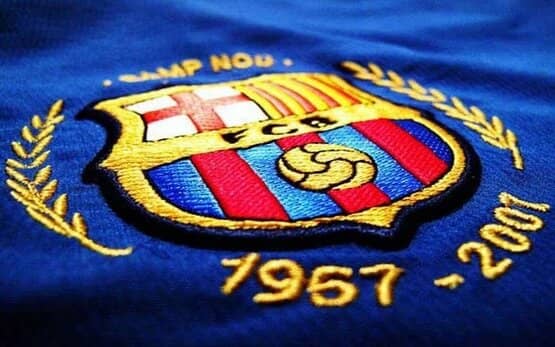
Since then, the ‘escudo’ has often been redesigned (most recently in 2002), but its core has not changed. The shape is still that of an "olla", a traditional Catalan food pot. The red cross on the white space on the upper left section is the Cross of Saint Jordi, the patron saint of Catalonia.
The section with the red-yellow strokes symbolizes the ‘senyera’, the traditional flag of Barcelona and Catalonia. The letters F.C.B. below are, of course, the initials of the club. The football in the lower section stands for the main sport in Barcelona, set on a background of blue and purple, the team colors.
Stadium Tour & Museum
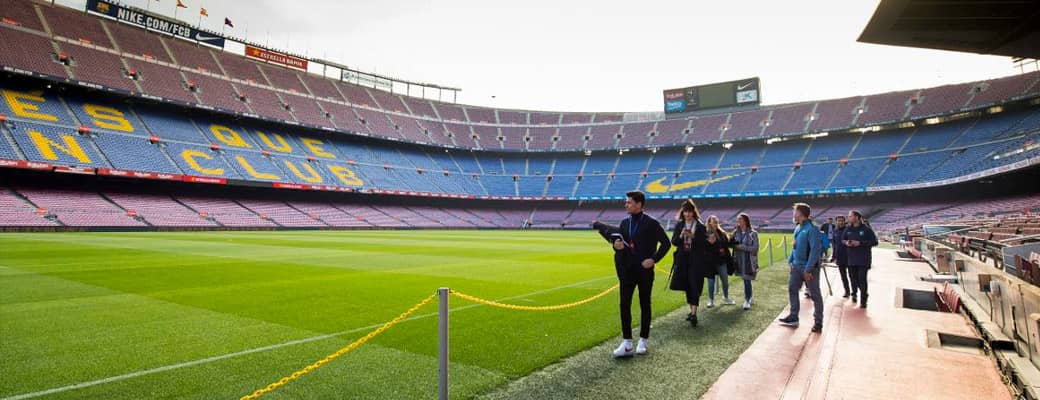
The Stadium Tour is called the “Nou Camp Experience” by the club, and they are right as it includes a visit to the Barça Museum which is quite an experience. The museum is the most visited museum in the country! From the players’ dressing rooms to the press room, the VIP box, the thrilling player tunnel and the pitch, no part of the behind-the-scenes space remains a secret.
The museum is not just a collection of great prizes, with its 111-year history on display, but there are also several notable personal relics of players and coaches who were once active for the club. Tickets for the stadium and museum tour can easily be added online when booking your trip to FC Barcelona football on our website.
What Does “Cule” Mean?
Barça fans in Spain are generally referred to as “Cules”. It literally means “ass” or “butt”. This originates far back in the long history of the club. Between 1909 and 1922, FC Barcelona played its home matches in the L'Escopidora stadium.
Supporters who could not afford the ticket would often climb and sit on the walls that surrounded the pitch, to make sure they could see the game. Only their backsides were visible to passers-by outside the stadium, who gave them the nickname “Cules”.
UNICEF to Back Shirt
The year 2006 marked the end of a wonderful 107-year-old tradition at FC Barcelona. For the first time in the history of the club there was a sponsor shown on the classic blue-purple shirt. However, it was not the name of a commercial brand, like so many other clubs in the world, but the logo of UNICEF, the United Nations children's rights organization.

The previous home shirt.
And where other clubs receive millions of dollars from their shirt sponsor, Barça donated a half million euros every year to UNICEF projects for children around the world. Through the links with UNICEF, which includes Lionel Messi being a UNICEF Ambassador, the club makes a positive contribution to the plight of children growing up in difficult circumstances such as hunger, poverty, disease or war.
"Through sports, children and adults across the globe can be connected and important messages can be conveyed," says Jan Bouke Wijbrandi, a Director of UNICEF. UNICEF has now made room for an additional deal with the Qatar Foundation. With that company, the club recently signed a five year sponsorship contract, worth an estimated thirty million euros per year.
Nou Camp
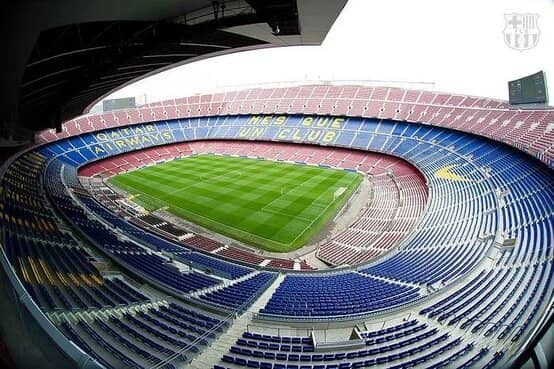
The Nou Camp - literally meaning "new field" - was opened on September 24, 1957 with a match between FC Barcelona and Legia Warsaw (4-2). The stadium has a capacity of 99,354 spectators and is 48 metres high; the field has a dimension of 105 x 68 metres. The Museum of FC Barcelona and the shop are located in the same complex. Besides football matches, pop concerts are also regularly held in the Nou Camp and on November 17, 1982 Pope John Paul II held a Mass in the stadium for 120,000 people.
Total Football
Dutch coach Rinus Michels introduced the so-called ‘total football’ style of play at Barcelona. A few years later the Dutch national team would, under the supervision of Michels, conquer the world with this distinctive style. It is extraordinary to see that this style of play is still fundamental to the way Barcelona plays today.
Canto del Barça (hymn)
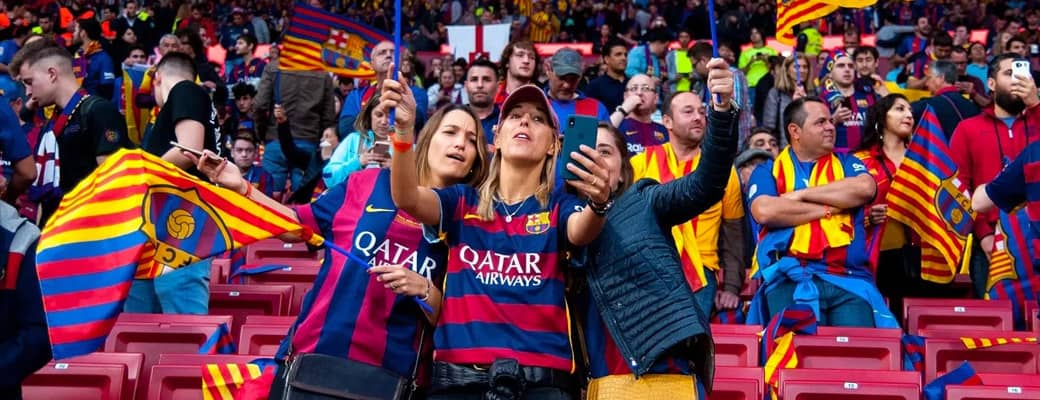
For every home game the Barcelona fans passionately sing the anthem. This is always a very impressive moment. Memorise the words so that you can join almost 100,000 other fans singing "El Canto”!
Tot el camp, és un clam, (The entire field is a clamour)
som la gent blaugrana, (we are the Blaugrana people)
tant se val d'on venim, (no matter where we come from)
si del sud o del nord, (be it south or north)
ara estem d'acord, estem d'acord, (now we all agree, we all agree)
una bandera ens agermana. (a flag unites us in brotherhood) Blaugrana al vent, (Blaugrana with the wind)
un crit valent, (a valiant cry)
tenim un nom, el sap tothom: (we have a name everyone knows)
Barça! Barça! Barça! (Barça! Barça! Barça!)
Jugadors, seguidors, (Players, supporters)
tots units fem força. (all together we are strong)
Són molts anys plens d'afanys, (Many years full of zeal)
són molts gols que hem cridat, (many goals we have screamed)
i s'ha demostrat, s'ha demostrat, (and it's proven, it's proven)
que mai ningú no ens podrà tòrcer. (no-one will ever beat us)
Blaugrana al vent, (Blaugrana with the wind)
un crit valent, (a valiant cry)
tenim un nom, el sap tothom: (we have a name everyone knows)
Barça! Barça! Barça! (Barça! Barça! Barça!)
The Nou Camp - literally meaning "new field" - was opened on September 24, 1957 with a match between FC Barcelona and Legia Warsaw (4-2). The stadium has a capacity of 99,354 spectators and is 48 metres high; the field has a dimension of 105 x 68 metres. The Museum of FC Barcelona and the shop are located in the same complex. Besides football matches, pop concerts are also regularly held in the Nou Camp and on November 17, 1982 Pope John Paul II held a Mass in the stadium for 120,000 people.
Nou Camp Tour
The behind-the-scenes stadium and museum tour is a great addition to complement the match you are attending.

The Nou Camp Tour is a great addition to your visit to the game.
The tour is self-guided and you can visit all the important areas of the stadium at your own pace, including the museum, trophy cabinet(s), the presidential terrace, dressing rooms, players' tunnel and the field . It is very impressive to see such a big stadium from the field. There are even people who find an empty stadium more impressive than a packed one! Tastes differ, but whatever your preference the Nou Camp Stadium Tour is a must during your trip to Barcelona football! The tour is easy to book together with your football trip (€ 25, - pp). You will receive the voucher for the tour together with your match tickets which will be delivered to the hotel reception. You can take the tour at your leisure during office hours. Since very recently it is not possible to do the stadium and museum tour on matchday.
Atmosphere
At every home game the supporters passionately sing the official anthem 'El Cant del Barça’. Watch this movie for a glimpse of this impressive moment. This movie was shot during a game against Real Madrid, when the atmosphere is obviously more intense than in any other league game!
Photos

View from the side.

On the metro to Camp Nou.

One of the many fanshops around the stadium.

Normal seating at the Nou Camp.
Barcelona is a great city and an ideal destination for a relaxing weekend. This vibrant city has a lot to offer in terms of culture, food, festivals, sports and fashion. The Gaudi buildings are impressive and unique for Barcelona. The beautiful beach and promenade give this capital of Catalonia its own identity. When you visit Barca, you will not only enjoy the football but also the beautiful city and its laid-back relaxed atmosphere.
Watch this video and get an impression of the atmosphere in Barcelona.
Here is an overview of the highlights of Barcelona:
Sagrada Familia
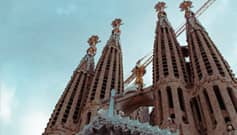
The Sagrada Familia is one of the landmarks of Barcelona. The Sagrada Familia is in many ways a unique and special sight. The church was designed by Antoni Gaudi, who designed many of Barcelona’s special buildings.

The Sagrada Familia is one of the landmarks of the city.
Not only is the architecture of the church unique and quirky, but also the progress of this building has its own history. Although the first stone was laid in 1882, the Sagrada Familia is still under construction and the expected completion date is now 2026. Despite this fact, or perhaps because of it, a visit to this unique church should definitely be a part of your visit to Barcelona! You can buy a ticket to visit the church and its museum. More information is available on the official website of the Sagrada Familia. Getting to the church is very easy - take the metro and get off at Sagrada Familia. On exiting the station you will see the impressive building right in front of you.
Metro: Sagrada Familia
Las Ramblas
Las Ramblas is a collection of pedestrianised streets running from Plaça de Catalunya, the centre of the city, to the harbour. This area is located in the heart of the city and you will find a collection of street performers, market stalls, cafés and shops under an archway of trees.

Las Ramblas, a famous area in the heart of Barcelona.
Because Las Ramblas is situated near the Gothic Quarter, Place de Catalunya and the port it is a major area in the heart of Barcelona.
Metro: Liceu, Catalunya and Drassanes
Casa Mila
This is an apartment building that is situated on the Passeig de Gracia. It was designed by Antoni Gaudi and completed in 1910. Like many other buildings of Gaudi, Casa Mila was innovative and unique at the time it was built. The building has not lost its magical appeal and it is mainly the undulating, almost surrealistic, shapes that make Casa Mila so unique.

Casa Mila, one of the famous 'Gaudi Houses' in the heart of Barcelona.
The building, also known as 'Le Pedrera' or 'The Quarry', has been listed on the UNESCO World Heritage Site since 1984. The building was originally commissioned by the noble Mila family but is currently owned by Caixa Bank. It is well worth going inside to explore the museum. There is a charge to visit a 2nd floor apartment of the building, which is authentically furnished, as well as access to the roof which resembles a fairytale-like garden of statues!
Metro: Passeig de Gracia
Casa Batllo
Like Casa Mila, this other famous 'Gaudi house' is also situated on Passeig de Gracia. The building was commissioned by textile magnate José Batllo I Casanovas and completed in 1906. Like Casa Mila (and almost all the works of Gaudi) this house is also characterized by the absence of corners.

The 'Gaudi house' Casa Batllo has a fairytale-like appearance.
The many curves, combined with the colourful mosaic that covers the entire facade, give this lovely building the appearance of a fairytale house. The house is now owned by the Bernat family (famous for the Chupa Chup lollipops) and it is not open to the public.
Metro: Passeig de Gracia
Plaça Reial
This plaza is right next to the Ramblas, in the Barri Gotic (Gothic Quarter). This beautiful square, in the middle of the city, is a great place to enjoy an evening drink on one of the many terraces (weather permitting).
Metro: Liceu

On the square you can also discover the striking street lamps designed by Antoni Gaudi.
Barceloneta
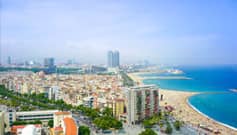
Barceloneta, especially the beach and promenade, is one reason why this city is so different from other cities. Where else can you combine a city walk with a drink on the seafront promenade or a swim in the Mediterranean? Barceloneta is the place to stroll along the long boulevard, have lunch at one of the great restaurants or just relax on the beach.

The beach is never far away in Barcelona, especially in Barceloneta.
The temperature of the sea from May to September is warm enough for swimming, but there are some enthusiasts who take a dip in the sea in other seasons too! Barceloneta is within walking distance of the city centre.
Metro: Barceloneta
Park Güell
Back in 1900, Easuebi Güell, a prominent resident of Barcelona, commissioned Gaudi to design a park which he then donated to the city. Park Güell features the typical quirky style of Gaudi. You will be amazed by the almost surreal images and ornamentation in the park, created with many mosaics. Since 1984, Park Güell has been included on the UNESCO World Heritage List.

Park Guell, the famous city park designed by Gaudi.
Your visit to 'the city of Gaudi' should definitely include a visit to this park! Entrance to the park is free. Although there is a bus stop near the park (line 24), the metro is an easy and reliable option. It is only a ten minute subway ride from the central station of Vallcarca to Lesseps (Line 3) from where it is a further half mile walk to the park.
La Boqueria
The Boqueria market is a wonderful fresh market in the middle of Barcelona. Whether you want to buy something tasty to take home or just want to take a look at this typical Spanish attraction, you will be amazed by what you see there.

Even if you do not buy anything, a visit to La Boqueria is a must.
The smell of fresh Iberico hams, the stalls with colourful fruits and vegetables and of course the typical market vendors, everything that happens on this market would look perfect on a postcard. And all this can be found in the middle of Barcelona, in Las Ramblas! The market is close to Metro station Liceu, but as it is somewhat hidden it may be necessary to ask directions to find the market entrance.
Metro: Liceu or Plaza Catalunya
Passeig de Gracia
This majestic main street runs from Plaça de Catalunya in the heart of Barcelona to the Gracia area in the north of the city. Passeig de Gracia is best known for its large international stores of famous brands and the Spanish chains Zara, Mango and Massimo Duti. This street is visited by up to seven million tourists who visit Barcelona each year. The "Paseo" is situated in the very centre of the city but is also reachable by metro.
Metro: Catalunya or Passeig de Gracia.
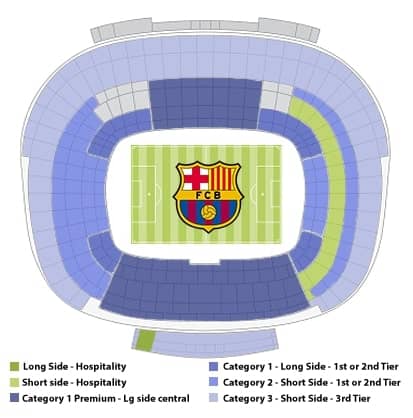
As standard we will reserve category 3 seating for you. It is possible to upgrade your seats should you wish. Upgrades are available to category 2 and category 1. An oversight of categories for FC Barcelona:
All categories offer you an excellent view of the pitch however it is recommended that you upgrade to at least category 2 for a small supplement as this will bring you even closer to the action!

The supplement for seating upgrades may vary with each package. You may choose your category of match seat in step 2 of the booking process.
Photo's

Category 3 - Seating on the third ring, short side. Official name: Goal 3.

Category 2 - Seating on the first or second ring, short side. Official name: Goal 1-2.

Mr Ellert with category 2 seating (1st ring).

Category 1 - Seating on the first or second ring, long side. Official name: Tribuna 1-2 or Lateral 1-2.